Списавшись с г-ном Chris Johnson, я попросил его поделиться парой фрагментов его книги с нашим сообществом. Автор любезно пошел мне навстречу и предоставил соответствующее разрешение. Фрагмент, с одной стороны, является тизером, который, возможно, кого-то побудят к покупке книги, с другой стороны, представляют из себя полезную информацию по интересующей нас теме.
23.1 RRC connection establishment
RRC connection establishment is used to make the transition from RRC Idle mode to RRC Connected mode. UE must make the transition to RRC Connected mode before transferring any application data, or completing any signalling procedures
The RRC connection establishment procedure is always initiated by the UE but can be triggered by either the UE or the network. For example, the UE triggers RRC connection establishment if the end-user starts an application to browse the internet, or to send an email. Similarly, the UE triggers RRC connection establishment if the UE moves into a new Tracking Area and has to complete the Tracking Area Update signalling procedure. The network triggers the RRC connection establishment procedure by sending a Paging message. This could be used to allow the delivery of an incoming SMS or notification of an incoming voice call
RRC connection establishment for LTE is relatively simple compared to RRC connection establishment for UMTS. The UMTS procedure requires NBAP and ALCAP signalling across the Iub interface between the Node B and RNC. These signalling protocols are used to setup a radio link and new transport connection. The flat network architecture for LTE removes the requirement for these signalling procedures
In the case of LTE, the initial Non-Access Stratum (NAS) message is transferred as part of the RRC connection establishment procedure. In the case of UMTS, the initial NAS message is transferred after the RRC connection establishment procedure. The approach used by LTE helps to reduce connection establishment delay
RRC connection establishment configures Signalling Radio Bearer (SRB) 1 and allows subsequent signalling to use the Dedicated Control Channel (DCCH) rather than the Common Control Channel (CCCH) used by SRB 0
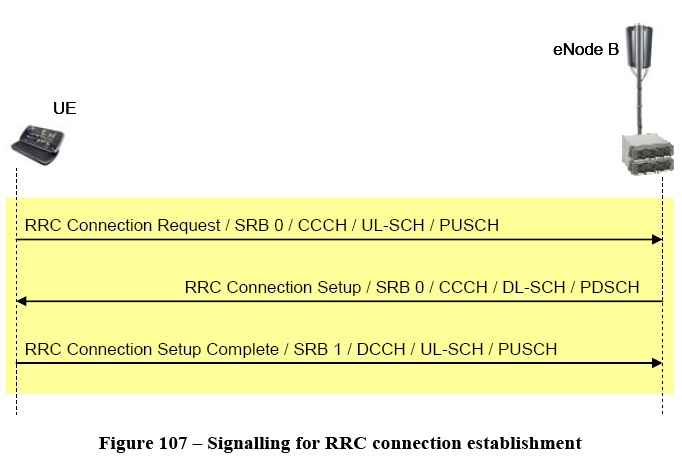
The signalling for RRC connection establishment is shown in Figure 107. The entire procedure is completed using only RRC signalling. A 3-way handshake is used to move the UE into RRC connected mode
Figure 107 – Signalling for RRC connection establishment
The RRC Connection Request message is sent as part of the Random Access procedure. It corresponds to the initial Layer 3 message shown in Figure 84 (section 21.1). It is transferred using SRB 0 on the Common Control Channel (CCCH) because neither SRB 1 nor a Dedicated Control Channel (DCCH) have been setup at this point. The uplink Resource Block allocation for the RRC Connection Request message is signalled within the Random Access Response message
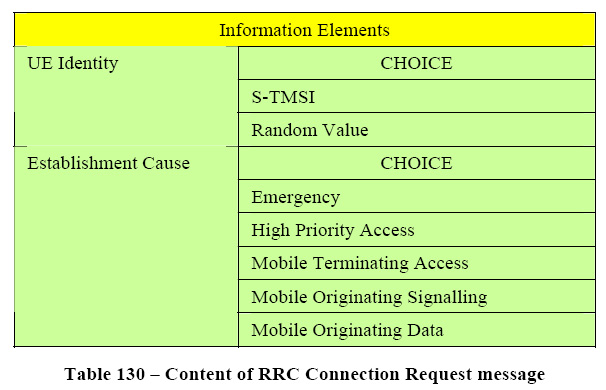
The content of the RRC Connection Request message is shown in Table 130. It includes a UE identity and an establishment cause. There is no scope for the UE to report any measurements within the RRC Connection Request message. The UMTS version of the RRC Connection Request message allows the UE to report CPICH measurements which can subsequently be used for downlink open loop power control calculations
The UE identity is signalled using the SAE Temporary Mobile Subscriber Identity (S-TMSI) if the UE is registered with the Tracking Area to which the current cell belongs. Otherwise, the UE selects a random number in the range from 0 to 2E40-1 to represent the UE identity. The S-TMSI is described in section 26.3.3
Table 130 – Content of RRC Connection Request message
The establishment cause within the RRC Connection Request message is determined by the Non-Access Stratum (NAS) procedure for which the connection is being established. The relationship between establishment cause and NAS procedure is specified by 3GPP TS 24.301. This relationship is presented in Table 131. In all cases, the RRC establishment cause is set to ‘High Priority Access’ if the UE uses Access Class (AC) 11 to 15. The list of establishment causes is significantly shorter than the list used by UMTS
Table 131 – Relationship between higher layer establishment cause and RRC establishment cause
The UE starts the T300 timer after transmitting the RRC Connection Request message. The value of T300 is broadcast within SIB 2. UMTS uses T300 in combination with N300 to manage re-transmissions of the RRC Connection Request message. LTE does not have an N300 parameter and the RRC Connection Request message is sent only once per establishment procedure. LTE uses the T300 timer to define how long the UE waits for a response to the RRC Connection Request message. The establishment procedure fails if T300 expires before receiving an RRC Connection Setup message. The procedure also fails if the UE completes a cell re-selection prior to receiving the RRC Connection Setup message
Random access contention can occur after sending the RRC Connection Request message. Section 21.1 explains that contention occurs when multiple UE select the same subframe and preamble sequence for PRACH transmission. Contention requires the UE to repeat transmission of the PRACH preamble and the subsequent RRC Connection Request message. This increases the delay associated with connection establishment but does not cause the overall procedure to fail unless the maximum number of preamble transmissions has been reached
Assuming that random access contention does not occur, the UE proceeds to wait for an RRC Connection Setup message from the eNode B. The UE has successfully completed the random access procedure so has been allocated a C-RNTI (signalled within the random access response message). The UE monitors the PDCCH for a downlink allocation addressed to its C-RNTI. The PDCCH specifies the set of PDSCH Resource Blocks used to transfer the RRC Connection Setup message. The RRC Connection Setup message is transferred using SRB 0 on the CCCH
The RRC Connection Setup message contains configuration information for SRB 1. This allows subsequent signalling to use the DCCH logical channel. SRB 2 is always configured after security activation so the RRC Connection Setup message does not include any information regarding SRB 2. The eNode B can instruct the UE to apply a default configuration for SRB 1, or it can instruct the UE to apply a specific configuration.
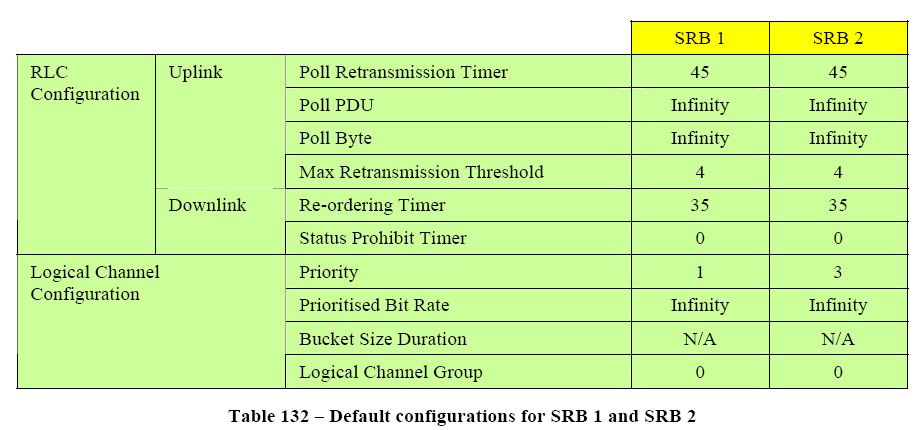
The default configuration for SRB 1 is presented in Table 132. This default configuration has been specified by 3GPP within TS 36.331. Using the default configuration helps to reduce the signalling requirement. The default configuration for SRB 2 is also presented in Table 132 for information. SRB 2 has a lower priority than SRB 1, i.e. a value of 3 represents a lower priority than a value of 1. Both SRB 1 and 2 always use acknowledged mode RLC
Table 132 – Default configurations for SRB 1 and SRB 2
The RRC Connection Setup message can also define configuration information for the PDSCH, PUCCH and PUSCH physical channels. It can also include information regarding uplink power control, CQI reporting, the Sounding Reference Signal, antenna configuration and scheduling requests
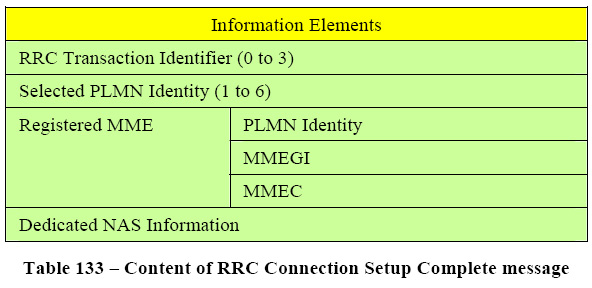
Upon receiving an RRC Connection Setup message, the UE stops the T300 timer and makes the transition to RRC Connected mode. The UE then proceeds to complete the procedure by sending an RRC Connection Setup Complete message. The content of the RRC Connection Setup Complete message is shown in Table 133
Table 133 – Content of RRC Connection Setup Complete message
The Transaction Identifier, combined with the message type, identifies the RRC procedure with the UE
The Selected PLMN Identity defines a pointer to a PLMN listed within SIB1, i.e. UE select the PLMN to which they want to connect when a cell belongs to more than a single PLMN
The Registered MME information is optional, and is included when available. It becomes available after a UE has registered with an MME. The MME is identified by its Globally Unique MME Identity (GUMMEI) which is a concatenation of the PLMN identity, MME Group Identity (MMEGI) and MME Code (MMEC). The MMEC identifies the MME within its group
The UE also includes its initial Non-Access Stratum (NAS) message within the RRC Connection Setup Complete message. NAS messages are specified within 3GPP TS 24.301. As indicated within Table 131, the NAS message could be an Attach, Detach, Tracking Area Update, Service Request or Extended Service Request message
The eNode B extracts the NAS message from the RRC Connection Setup Complete message and forwards it to an MME using the S1 Application Protocol (S1-AP) Initial UE Message. Forwarding this message does not form part of the RRC establishment procedure but is described within this section for completeness
The content of the S1-AP Initial UE Message is shown in Table 134. The eNode B sends this message to the appropriate MME based upon its NAS Node Selection Function (NNSF). In the case of a Service Request, the S-TMSI included within the RRC Connection Request is used to identify the appropriate MME (S-TMSI includes the MMEC). In the case of an Attach or Tracking Area Update, the eNode B uses the GUMMEI included within the RRC Connection Setup Complete message. The eNode B is free to select an MME when the UE does not have an S-TMSI nor GUMMEI
The eNode B allocates the eNode B UE S1-AP Identity to allow the eNode B to identify the UE within S1 signalling procedures. The MME UE S1-AP Identity (not included within the Initial UE Message) allows the MME to identify the UE within S1 signalling procedures
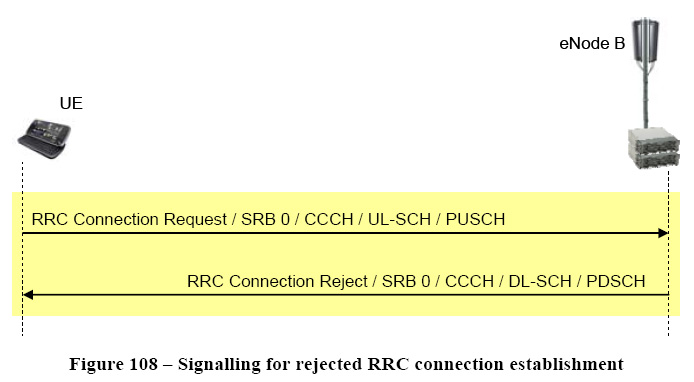
Figure 108 illustrates the signalling associated with the RRC connection establishment procedure when the eNode B rejects the RRC Connection Request. The reject message is returned to the UE using SRB 0 on the CCCH logical channel. The eNode B may reject the connection establishment request as a result of congestion
Figure 108 – Signalling for rejected RRC connection establishment
The content of the RRC Connection Reject message is presented in Table 135. The message only includes a wait time. This is in contrast to the equivalent UMTS message which also includes a rejection cause, although the UMTS rejection cause can only be defined as congestion or unspecified The UMTS message can also include redirection information to direct the UE towards another RF carrier, or Radio Access Technology (RAT)
Table 135 – Content of RRC Connection Reject message
Upon receiving an RRC Connection Reject message, the UE starts the T302 timer with its value set equal to the wait time. Access Class barring for mobile originating calls, mobile originating signalling and mobile terminating access is applied until T302 expires, i.e. the UE is not allowed to send another RRC Connection Request for those connection types, and to the same cell, until T302 expires. T302 is stopped if the UE completes cell reselection. In that case, the UE is permitted to send an RRC Connection Request to the new cell
In contrast to UMTS, LTE requires the higher layers to initiate a new connection establishment procedure after the UE receives an RRC Connection Reject message. UMTS allows the RRC Connection Request message to be repeated from the RRC layer, based upon the value of N300